


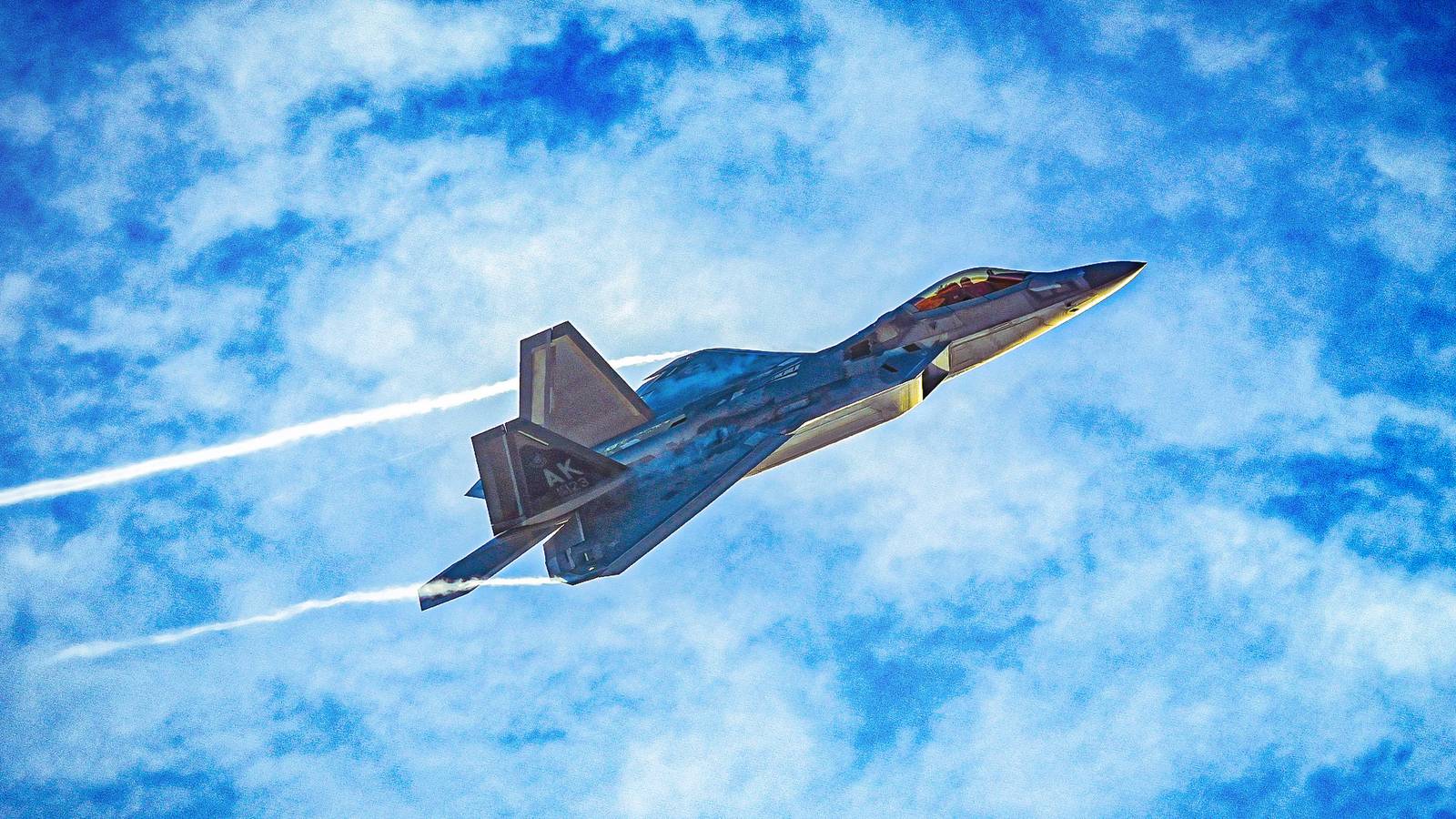
What is the fuel efficiency of the F-22 Raptor? The short answer is “it depends.” A slightly longer, and equally unsatisfying answer is “it’s better at supercruise, and when carrying munitions, but like all high-performance jets, it’s still awful.” Fighter jets are not built for fuel efficiency, and this severely limits their operational ranges, especially their realistic combat ranges. Fuel consumption is heavily influenced by payloads, speed, mission type, altitude, and much more.
Here are some starters for the conversation about how many miles per gallon a Raptor gets. Keep in mind that real-life fuel consumption of the F-22 varies, and some aspects are classified, so derived estimates are used. One other note is that miles per gallon is typically the way fuel consumption in automobiles is calculated. In aviation, fuel is expressed in pounds (lbs).
Fuel Capacity Of The F-22 Raptor

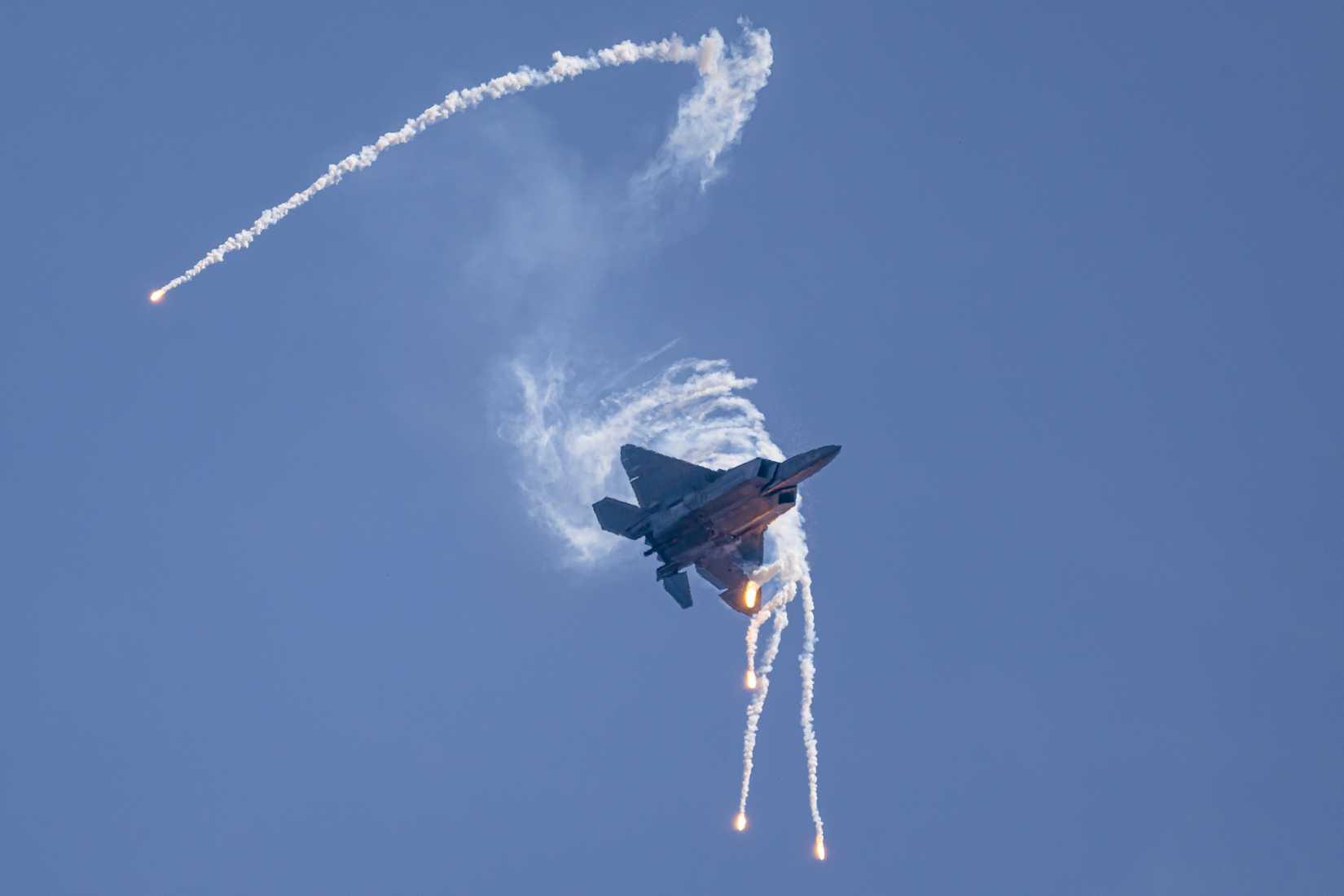
Being a stealth fighter is tricky. To preserve its stealth profile, the F-22 (like the F-35) was designed to carry both munitions and fuel internally. Although it does have the ability to carry these externally at the expense of its stealth profile. This not only limits the munitions it can carry, but also means it can’t carry drop tanks, greatly impacting its range. The Air Force is working on remedying this by developing special stealthy drop tanks for the Raptor (and possibly the F-35).
In 2024, a Raptor was spotted flying with new stealthy external fuel tanks. The War Zone reported in 2024, “The goal now is to get the ball rolling on production later this year and begin deliveries of tanks to F-22 squadrons by the end of March 2026.” Presently, the F-22 carries 600-gallon non-stealthy external drop tanks. It is unclear what the fuel capacity of the new stealth fuel tanks being developed is. It is possible they will be smaller than existing non-stealthy tanks.
Using just internal fuel, the F-22 Raptor has a capacity for around 18,000 lbs (8,165 kg or 2,700 gallons) of fuel. Adding two external 600-gallon tanks adds another 8,000 lbs of fuel. It should be noted that the Raptor can use the existing non-stealthy tanks to get closer to the conflict area, even if they are dropped before entering it.
The Raptor’s Ferry Range


The F-22 is powered by a pair of Pratt & Whitney F119-PW-100 engines. Each provides approximately 26,000 lbf of dry thrust and 35,000 lbf with afterburners. If we assume the most optimal scenario for the F-22 to ferry the aircraft as far as possible, then the optimum cruising speed is around Mach 0.85 (around 530–560 mph) at an altitude of around 35,000 feet or more. In this scenario, the aircraft can be expected to burn around 9,000–10,500 lbs of fuel per hour.
If the F-22 is carrying external drop tanks, then range increases, but the weight and increased drag drive up the Raptor’s fuel burn to around 11,500–13,000 lbs per hour. When it comes to range, a clean Raptor can be expected to have a range of 850 to 1,000 miles (1,370–1,600 kilometers) one way and a combat radius of around 450–500 miles (720–800 kilometers). With drop tanks, the Raptor can ferry around 1,600–1,850 miles (2,750–3,000 kilometers).
|
Approx. F-22 ranges with internal fuel (derived per US Air Force, Congressional docs, others) |
Range (one way) |
Range (combat radius) |
Miles per gallon |
|---|---|---|---|
|
Clean subsonic |
850–1,000 miles |
450–500 miles |
0.34–0.40 mpg |
|
Clean supercruise |
600–750 miles |
300–375 miles |
0.30–0.37 mpg |
|
Clean afterburners |
200–250 miles |
n/a (very low) |
0.11–0.13 mpg |
In terms of flight endurance, the F-22 can be expected to fly for a total of around 3 hours when carrying its full 26,000 lbs load of fuel with tanks. As the Raptor does not currently have stealth drop tanks, this is currently redundant for combat missions. Expressed in miles per gallon (as indicated by the title of this article), the F-22’s optimal efficiency is somewhere in the ballpark of 0.34–0.40 miles per gallon. This is somewhat comparable to other fighter jets like the F-35, F-15EX, and Su-35.
F-22 Raptor’s Range At Supercruise


Fuel consumption is nonlinear, and once aircraft go supersonic, their fuel consumption spikes. The F-22 can supercruise at Mach 1.5 with no afterburner. Here, the Raptor can be expected to get around 0.045–0.055 miles per lb. Expressed in miles per gallon, it’s around 0.30–0.37 mpg. While this may sound thirsty, and indeed it is, it is actually very fuel-efficient for sustained supersonic flight. Any other 4th-generation fighter jet would need afterburners to sustain these speeds and would burn 2–3x more fuel.
At supercruise, the Raptor’s range will fall to around 600–750 miles (965–1,200 kilometers). Also note that these ranges are without drop tanks. Going supersonic with external tanks imposes a massive drag penalty and is usually simply not viable. Fuel efficiency with external tanks at supersonic speeds collapses.
That said, in the real world, an F-22 can carry drop tanks part of the way, then drop them before switching to internal fuel and supercruising. Supercruise for the Raptor can be the sweet spot between going fast and being fuel-reasonable. Afterburner (discussed below) destroys range and is only used sparingly.
F-22 Raptor’s Range With Afterburners

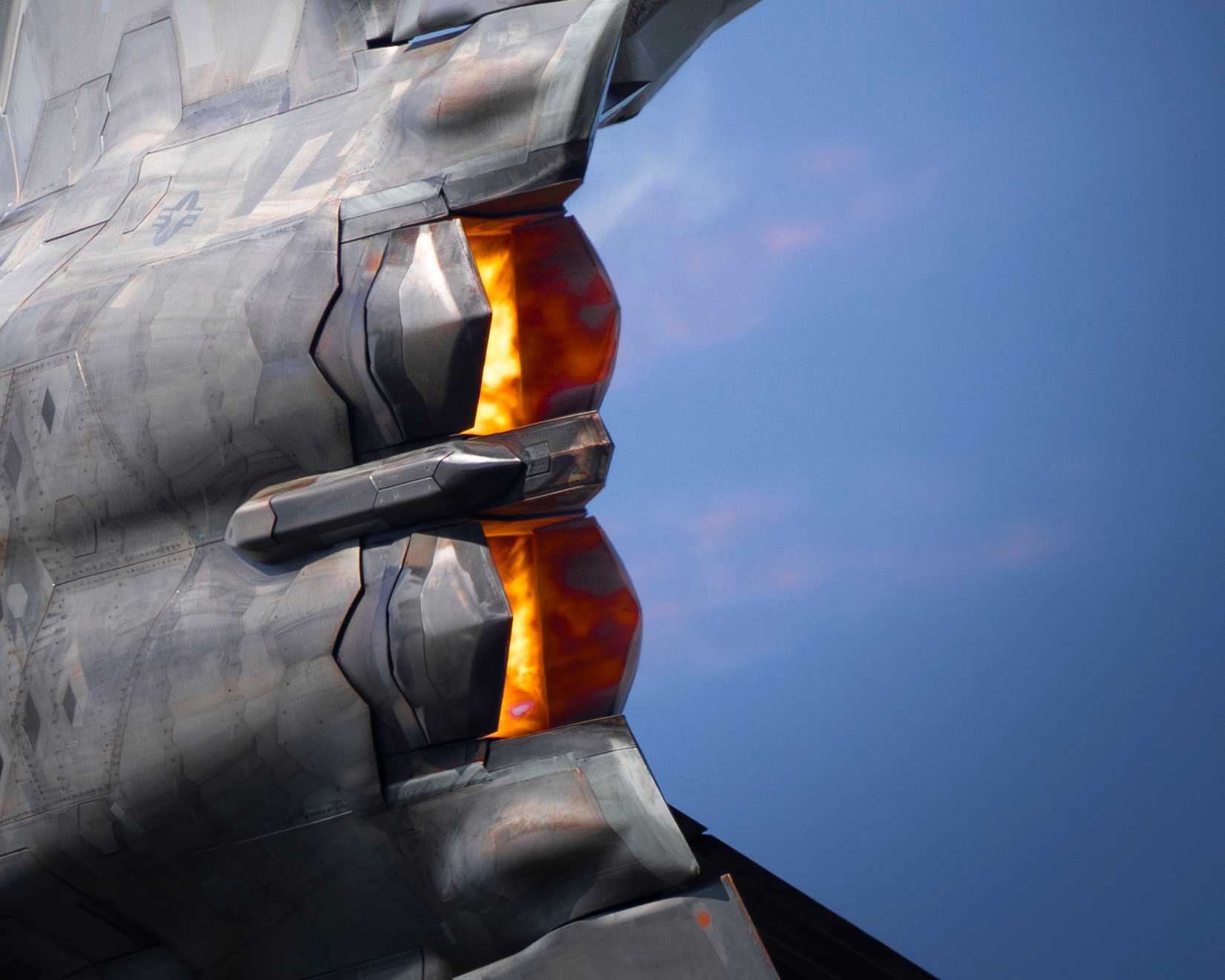
As stated, if the Raptor is to use afterburners, then external tanks are out of the picture. Firstly, it should be noted that the usable fuel is not the same as the fuel capacity. The Raptor may have a capacity of 18,000 lbs, but its usable fuel with afterburners is closer to 12,000 lbs. This is because not all fuel can be safely or practically burned in flight. When operating with afterburners, around 600–900 lbs of fuel is effectively unreachable, while more is “protected” by the aircraft.
Going full afterburner (around Mach 1.8-2.0), the Raptor has an efficiency of 0.025–0.030 miles per lb or 0.11–0.13 mpg. Afterburners remain useful to modern fighter jets, but they have become a special-purpose tool. They are more for things like breaking contact and escaping a threat. They can also be used in cases of last-resort survivability (e.g., emergency climbs), heavy takeoff conditions, and more.
As a rule of thumb, the use of the afterburner in combat can guzzle around 10-15% of the aircraft’s total fuel per minute. Afterburners are for dashes and sprints; they are not for sustained flight. If the aircraft were to sustain flight with afterburners, its combat radius would collapse to around 150–200 miles, perhaps less. Afterburners also emit massive infrared plumes, undermining its stealth profile.


Why Is The F-22 Raptor Slower Than The 52-Year-Old F-15 Eagle?
Stealth and maneuverability versus unbridled power and speed – discover how two great American jets stack up, head to head.
Realistically, It Can Be Very Different

The above combat calculations are assuming a rather simple scenario where the Raptor takes off, flies in a straight line, releases its munitions, and flies back. In the real world, things are different. Operating in a combat setting often involves weaving between enemy air defenses where they have been assessed as the weakest and where the aircraft can exploit gaps. Aircraft may also want to loiter over a target or in a combat zone for longer, meaning it’s not just “get in, get out.”
Another factor is that to avoid enemy radar, an aircraft may have to fly over the map of the Earth. This is shown in the 2022 movie Top Gun: Maverick, although the canyon run in the movie suspiciously resembles that of the run on the Death Star in the original Star Wars movie. Flying the map of the Earth at below 5,000 feet drastically lowers fuel efficiency. Not only is the air much denser, but the aircraft may have to conduct far more maneuvers around terrain.
This can increase fuel burn by 40% to 60% compared with high-altitude cruising. In this scenario, fuel consumption can rocket to around 16,000 lbs per hour, slicing the aircraft’s time in the air to just over an hour. If the scenario were to be jacked up to a dogfight with max afterburners, the Raptor may only be able to sustain that for less than 20 minutes. That said, the Raptor is built to take out enemy aircraft before there is a dogfight to be had.
The F-22’s Lighter Combat Load Penalty


Real combat profiles are likely to cut the efficiency by 20–30% compared with a ferry flight. Still, the Raptor’s combat load penalty is comparatively light. This is due to a few reasons, one of which is that it is an air dominance fighter designed to carry comparatively light air-to-air missiles and not heavy bombs. That said, the weight difference is secondary; the primary factor is drag. For comparison, the F-15 carries its stores externally.
External stores induce parasite and interference drag, and they impose a higher fuel burn at all speeds. The F-15 is fundamentally a 1970s design built for raw thrust, not drag minimization. The bespoke F-22 is designed from the ground up for low drag at high speeds. Carrying internal missiles only, the Raptors’ range penalty may only be 10% or even less. The F-15C, with external stores, may have a range penalty of 30% to 45%.
The F-15’s high combat range penalty is one of the core reasons why the F-22 Raptor was built in the first place. Whereas a combat-loaded F-15C can have a combat range of around 300–350 miles, the F-22 can extend that to around 400–450 miles. This is another factoid highlighting that there is so much more to stealth than just its radar cross-section. Carrying stores internally not only increases stealth but also increases range.
link