


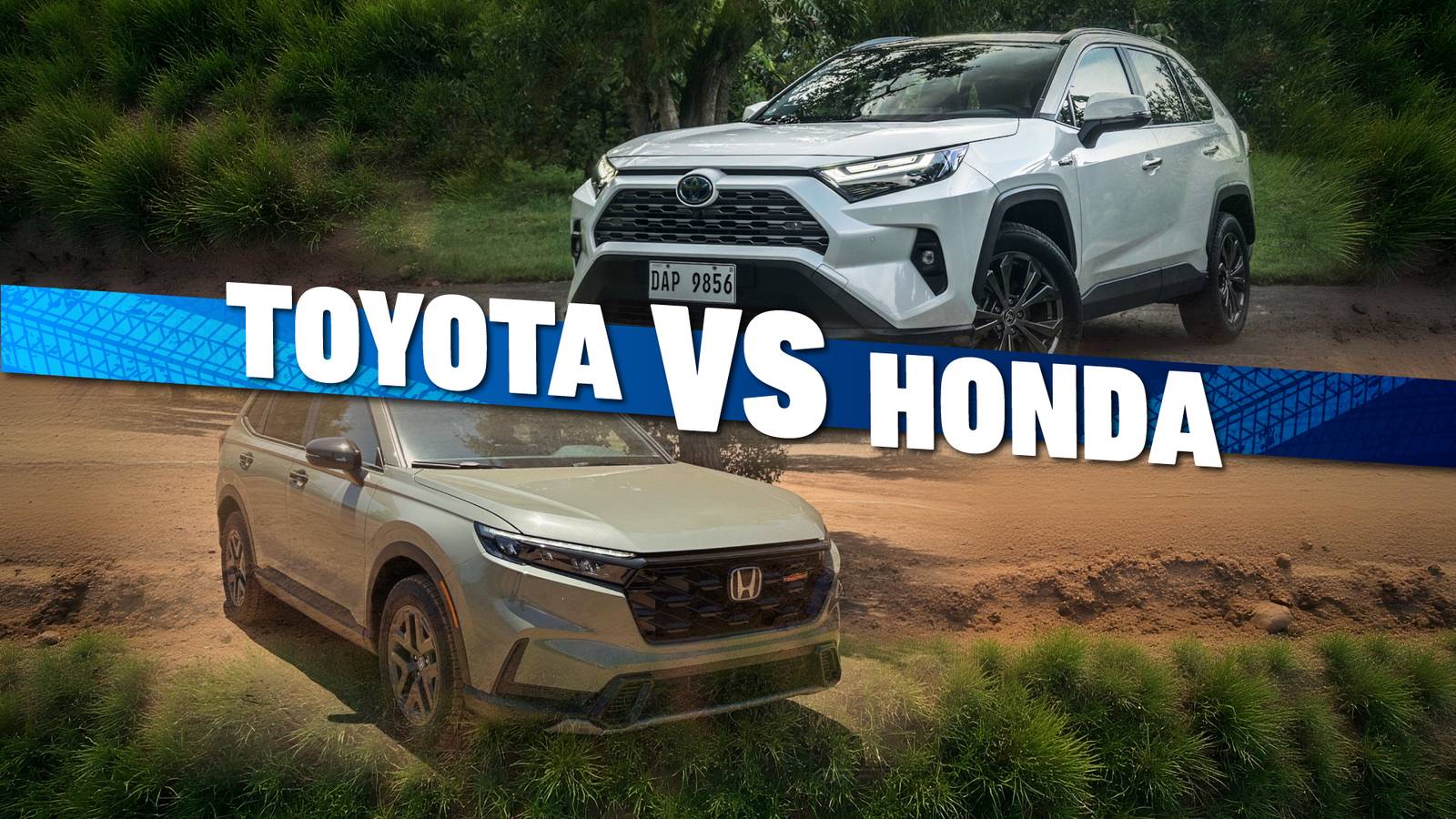
The Toyota RAV4 and Honda CR-V are currently the most popular midsize SUVs in the U.S. This has been the case for many years, as both Japanese brands have consistently designed these to offer what the average American consumer wants. Crossovers and SUVs have been taking over as the new mainstream option above sedans due to their better overall value and more expansive versatility.
The RAV4 and CR-V are also popular because they benefit from a longstanding reliability and low long-term costs. Currently, the Toyota RAV4 is the best-selling SUV, but if we look at the hybrid models specifically, the CR-V is the more popular option. Both of these models return similar costs, but
Ownership Costs: 2025 Toyota RAV4 vs. 2026 Honda CR-V
-


- Base Trim Engine
-
2.5L Dynamic Force I4 ICE
- Base Trim Transmission
-
8-speed automatic
- Base Trim Drivetrain
-
Front-Wheel Drive
- Base Trim Horsepower
-
203 HP @6600 RPM
- Base Trim Torque
-
184 lb.-ft. @ 5000 RPM
- Base Trim Fuel Economy (city/highway/combined)
-
27/35/30 MPG
-


- Base Trim Engine
-
1.5L I4 Turbo
- Base Trim Transmission
-
CVT
- Base Trim Drivetrain
-
Front-Wheel Drive
- Base Trim Horsepower
-
190 HP @6000 RPM
- Base Trim Torque
-
179 lb.-ft. @ 1700 RPM
- Base Trim Fuel Economy (city/highway/combined)
-
28/34/30 MPG


According to Edmunds, the base 2026 Honda CR-V LX will cost you $43,628 to own over five years and 60,000 miles. Estimations indicate that it loses $9,861 of its $30,920 base MSRP over the course of five years and 60,000 miles, which is an incredible value retention rate by midsize SUV standards. You can also expect to spend $5,320 on maintenance and $917 on repairs. Using similar metrics, CarEdge indicates that the very same model loses 34 percent of its value, resulting in it being worth $23,507, and that you will spend $33,935 over five years.
2025 Honda CR-V Hybrid True Cost To Own
| Year 1 | Year 2 | Year 3 | Year 4 | Year 5 | Total | |
|---|---|---|---|---|---|---|
| Insurance | $1,059 | $1,096 | $1,134 | $1,174 | $1,215 | $5,678 |
| Maintenance | $206 | $724 | $524 | $2,102 | $1,764 | $5,320 |
| Repairs | $0 | $0 | $133 | $318 | $466 | $917 |
| Taxes & Fees | $2,901 | $242 | $232 | $222 | $210 | $3,807 |
| Financing | $1,971 | $1,591 | $1,181 | $742 | $269 | $5,754 |
| Depreciation | $3,220 | $1,617 | $1,529 | $1,794 | $1,701 | $9,861 |
| Fuel | $2,315 | $2,384 | $2,456 | $2,530 | $2,606 | $12,291 |
| True Cost to Own | $11,672 | $7,654 | $7,189 | $8,882 | $8,231 | $43,628 |
J.D. Power gives the Honda CR-V range an 84/100 quality and reliability score, an 85/100 score for resale, 83/100 for the driving experience, and 81/100 dealership experience score, bringing its overall consumer-verified rating up to 83/100. iSeeCars holds a similar sentiment with the CR-V Hybrid, highlighting that it will cover 13.8 years or 169,210 miles before encountering any major mechanical issues, with a 30.1 percent probability of reaching 200,000 miles, earning it an 8.2/10 reliability score. It will also lose 43 percent or $14,755 of its value after five years, resulting in the Japanese HEV SUV earning an 8.0/10 retained value score.
Where research meets the right deal
According to Edmunds, you can expect to spend $44,667 over the course of five years and 60,000 miles on the base 2025 Toyota RAV4 LE, making it a slightly more expensive option to own compared to the base CR-V. $5,119 accounts for maintenance, $772 for repairs, $9,940 for depreciation, and $12,291 for fuel.
2025 Toyota RAV4 LE True Cost To Own
According to CarEdge’s depreciation calculator, the Toyota RAV4 will cost you $35,894 after five years and 60,000 miles of ownership, with key costs including $10,377 on depreciation, $7,700 on fuel, and $1,938 on maintenance and repairs.
J.D. Power issues the RAV4 with a 79/100 consumer-verified overall score, which includes 77/100 for quality and reliability, 79/100 for the driving experience, 88/100 for resale, and 76/100 for the dealership experience.
Where research meets the right deal
Owner Reviews And Common Problems
The Honda CR-V has a 4.2/5 average score on the Edmunds consumer review section, 62 percent of which are five-star ratings. Owners indicate a good ride quality, spacious interior, and impressive fuel consumption returns to be standout benefits, but some have criticized it for featuring uncomfortable seats, substandard safety systems, and limited outward visibility.
We also have to point out that there are some comments criticizing this model’s reliability, but these are a handful of owner-submitted reviews, which we cannot use to paint an overall picture of its mechanical integrity. There are currently three active recalls for the Honda CR-V related to an improperly installed fuel house, a high-pressure fuel pump leak, and a bad power-steering motor.
The Toyota RAV4 currently has a 4.4/5 average score on the Edmunds consumer review section, 71 percent of which are five-star ratings. Key benefits include its fuel efficiency, spacious interior, and ride quality, but there have been some concerns surrounding its loud road noise, infotainment system, and dashboard. The NHTSA only lists one active recall for the Toyota RAV4 related to a possible instrument panel failure, which in the real world would make it a more reliable option compared to the CR-V.
Performance And Efficiency
The Honda CR-V’s drivetrain system achieves a pretty impressive 29/33/30 MPG EPA consumption estimate on the city/highway/combined cycle for the front-wheel drive option. The all-wheel drive model returns a slightly worse 27/31/29 MPG result. The 14-gallon gasoline tank gets you 420 miles of range in front-wheel drive guise, which the all-wheel drive system lowers to 406 miles.
2025 Honda CR-V Hybrid EPA Estimates
The RAV4 LE’s system will return a 34/30/27 MPG fuel consumption on the city/highway/combined cycle and return a 435-mile range on a full tank of gasoline. You can expect to save $500 worth of fuel costs over five years, while spending $1,500 on fuel every year and $2.52 to drive 25 miles. A full tank of gas for the 14.5-gallon tank will set you back by around $44.
2025 Toyota RAV4 EPA Estimates
| FWD LE | AWD | |
| Fuel Consumption (City/Highway/Combined) | 27/34/30 MPG | 27/33/29 MPG |
| Range | 435 Miles | 420 Miles |
| Fuel Savings In Five Years | $500 | $250 |
| Annual Fuel Cost | $1,500 | $1,550 |
| Cost To Drive 25 Miles | $2.52 | $2.60 |
| Cost To Fill The Tank (14.5 Gallons) | $44 | $44 |
The lower-trim all-wheel drive models return a 27/33/29 MPG result with a slightly less preferable 420-mile range. This will save you $250 in fuel over five years, while you spend $1,550 on fuel every year and $2.60 to drive 25 miles.
Verdict: Honda Masters Affordability Through Efficiency And Value
Affordability is a major contention when it comes to two of the most popular SUV options in the U.S., with both the Toyota RAV4 and Honda CR-V returning highly preferable long-term running costs. Just based on the figures that we’ve quoted, the CR-V ultimately edges the win, while matching the RAV4’s efficiency. It is a slightly more expensive option, but when you look at the level of standard features the LX includes, we’d argue that it is a slightly better proposition.
The existing RAV4 is in its final days, as Toyota prepares the all-new generation for the market, with official pricing and specification readily available. This will be a hybrid-only model, which may ultimately make it a more expensive model to own in the long run, but if the current-generation hybrid is anything to go by, it may not be anywhere near as bad as one might expect.
Sources: J.D. Power, iSeeCars, Edmunds, the NHTSA, and CarEdge.
link