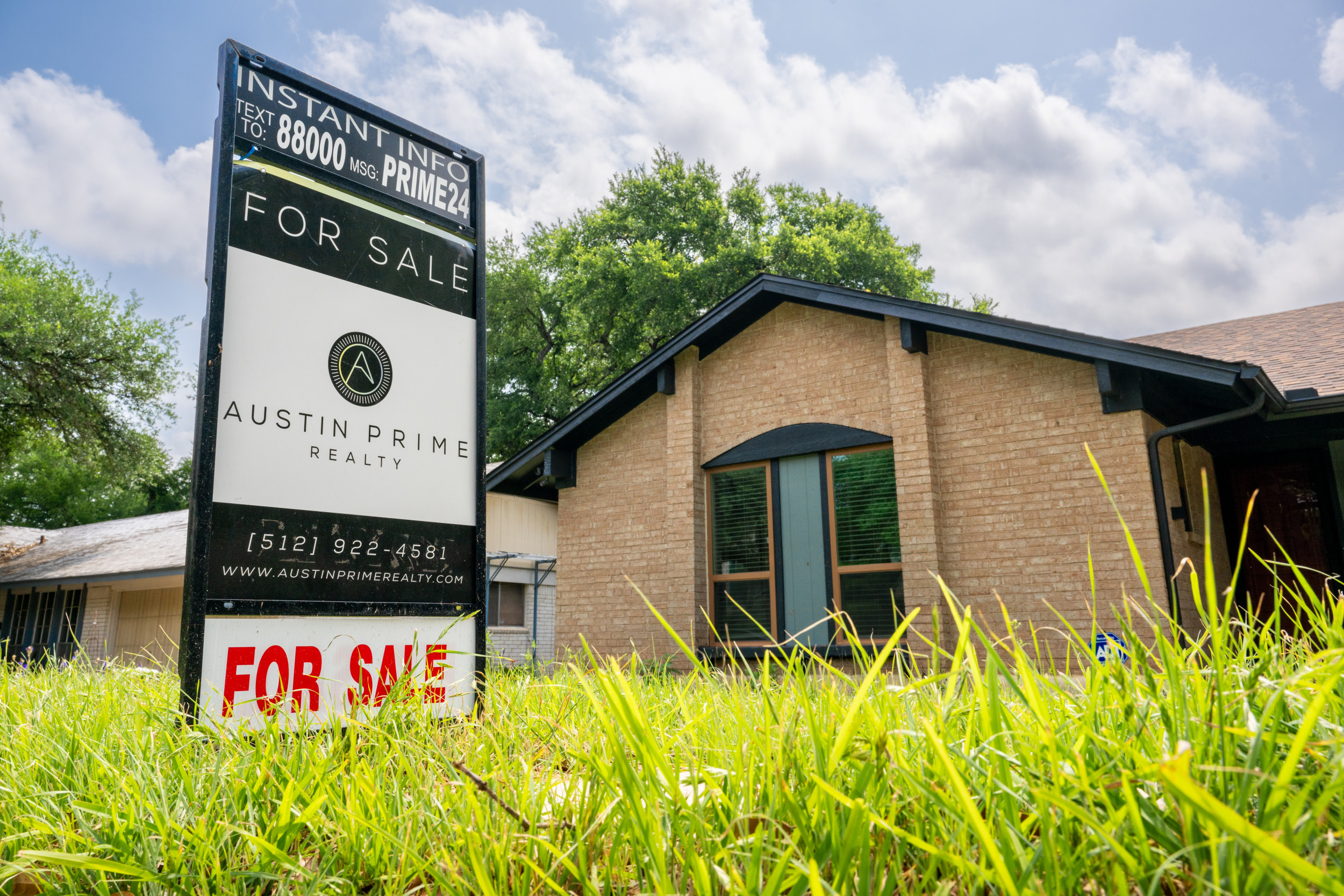
Homeowners selling real estate in some of the United States’ largest metro areas are falling short of reclaiming the full amounts they originally paid for their properties.
Why It Matters
The housing market remains contentious for many Americans who want to purchase starter homes or new builds but simply cannot afford elevated mortgage rates, rising home insurance premiums and property taxes, even as the national inventory is growing. Prices are rising and sales are falling.
What To Know
The current state of the market may benefit buyers rather than sellers as active U.S. listings last month reached a five-year high, according to data reported by real estate brokerage Redfin on Monday.
That is attributed to sales taking longer to complete, as the typical rate of 38 days represents the slowest May selling pace since 2020.

Brandon Bell/Getty Images
Roughly 6 percent of today’s U.S. home sellers are at risk of selling for less than their purchase price, according to Redfin, up from 4.4 percent a year ago but below pre-pandemic levels.
The major metros where sellers overall, no matter what kind of home, are finalizing deals with the biggest losses:
- San Francisco, California: -19.6 percent
- Austin, Texas: -13.8 percent
- Oakland, California: -11 percent
Major metros with the lowest share of homes at risk of selling for a loss:
- Providence, Rhode Island: -0.5 percent
- New Brunswick, New Jersey: -0.5 percent
- Anaheim, California: -1 percent
The report shows that nearly 1 in 6 (16.4 percent) of sellers who purchased their homes post-pandemic are at risk of selling for less than their purchase price, compared to 9 percent of sellers who bought their home during the pandemic and are at risk of selling at a loss.
Only 1.8 percent of sellers who bought homes prior to the pandemic are at risk of finalizing deals at a loss.
Redfin, which analyzed active listings on the MLS in May, defines the pandemic period as July 2020 to July 2022.
Redfin senior economist Asad Khan told Newsweek on Tuesday that what is happening market-wise can be viewed as the flip side of the very rapid run-up in home prices during the pandemic.
“While the vast majority of sellers enjoyed dramatic gains in equity as a result of that surge in home values, those who bought at or after the peak of the surge saw much less appreciation,” Khan said. “Many of those who bought at that time might have overextended themselves, expecting prices to keep rising quickly.
“But, for the most part, even those sellers who bought after the pandemic are not facing the risk of a loss, at least at current prices.”
When it comes to single-family homes, about 13.2 percent of for-sale single-family homes in Austin are at risk of selling at a loss. That’s followed by San Antonio, Texas, (10.2 percent) and St. Louis, Missouri (10 percent).
More than one-third (35.6 percent) of for-sale condos in San Francisco are at risk of selling at a loss, drastically higher than the next two major metros on the list pertaining strictly to condos: Portland, Oregon, (24.8 percent) and Oakland (23.2 percent).
Khan said that condo prices in particular have been “weak,” with metros in Florida, Texas and California seeing less price growth, while prices are below their pandemic peaks in metros like San Francisco, Austin and Tampa—regions that generally saw significant housing construction during the pandemic boom or are facing other headwinds, like increased HOA fees or special assessments for condos in Florida.
Khan said the data actually instills confidence in the health of the overall housing market.
“With most sellers sitting on significant equity, the risk of widespread mortgage foreclosure is low,” he said. “In fact, because most sellers can expect to sell for a price higher than the price at which they purchased their home, motivated sellers can still find buyers if they are flexible on price.
“And this is good news for buyers, since sellers who aren’t facing a loss might be more willing to negotiate on price. With high mortgage rates still suppressing buyer demand, we see these data as a further indication that there is room for price growth to slow and potentially fall.”
About 47.5 percent of for-sale homes in Austin that were bought after July 2022 are at risk of selling at a loss.
What People Are Saying
Denver Redfin Premier agent Andy Potarf, in a statement: “We are seeing the biggest price drops in the condo market. I had a seller who bought a condo for $570,000 in 2021 and it just sold for $525,000 last week. Sellers who have to sell are willing to take a bigger hit to get the deal done.”
What Happens Next
Housing affordability is unlikely to ease anytime soon, according to a new report by the Joint Center for Housing Studies of Harvard University.
While prices have continued rising this year, total existing-home sales in the U.S. dropped to a 30-year low of 4.06 million, the study found.
Update 6/24/25, 5:50 p.m. ET: This article was updated with comment from Khan.
link
About the Author