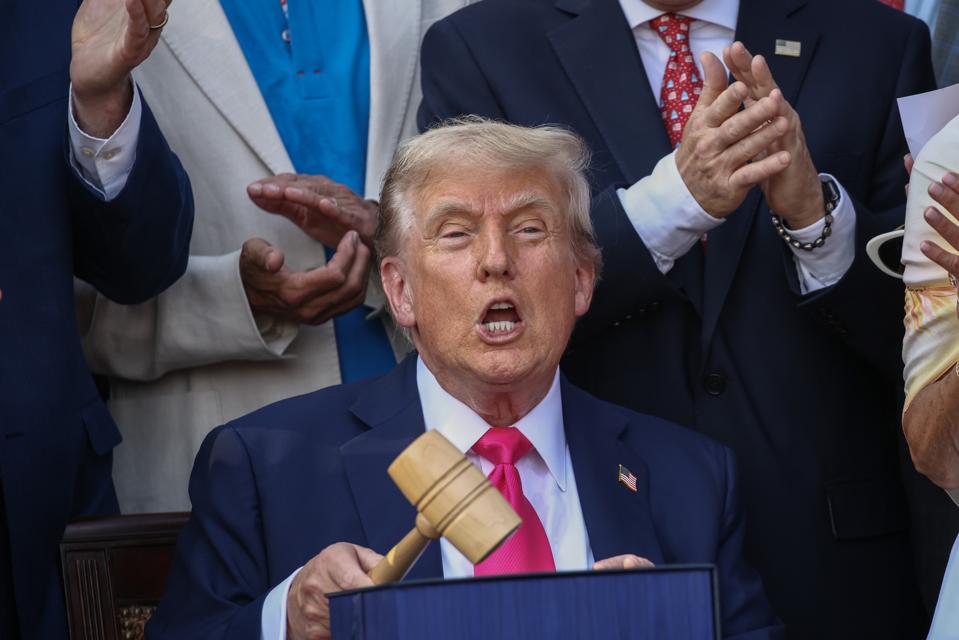
WASHINGTON, DC – JULY 04: U.S. President Donald Trump, joined by Republican lawmakers, signs the One, Big Beautiful Bill Act into law on the South Lawn of the White House on July 04, 2025 in Washington, DC. The bill makes significant changes to federal student loan repayment plans, which critics argue my lead to sharp increases in monthly payments. (Photo by Samuel Corum/Getty Images)
Getty Images
Millions of federal student loan borrowers will experience sharp increases in their monthly payments in the coming months, according to a new analysis by a borrower advocacy organization. Payments could increase by $400 per month or more, on average.
The changes stem from the “One, Big Beautiful Bill Act” that President Trump signed into law in July. The OBBBA will lead to the eventual repeal of several student loan repayment plans designed to provide borrowers with affordable payments tied to their income. Once that repeal is complete, borrowers would only have access to two remaining income-driven plans, at most. But for many borrowers, these plans will be more expensive that the most affordable current options. This is particularly true for borrowers who take out any new federal student loans or consolidate existing loans starting next summer.
“The OBBBA will have financially devastating consequences for borrowers, students, and their families and will make paying for college more expensive and risky,” said Protect Borrowers in its new analysis published earlier this month. “Millions of borrowers will be pushed toward costlier federal loan repayment plans, regardless of when they took out their loan.”
Here’s a breakdown of who might see higher student loan payments as a result of the OBBBA, and when.
Student Loan Payment Increases For Current Borrowers
Income-driven repayment plans (also known as IDR plans) are a lifeline for many student loan borrowers, offering them affordable payments based on a formula applied to their income and family size. Payments are typically recalculated every year and are adjusted based on changes to income. Historically, borrowers would be entitled to student loan forgiveness for any remaining balance after 20 or 25 years in repayment, depending on the plan.
Under the provisions of the OBBBA, three of four current IDR plans will be eliminated: ICR, PAYE, and SAVE. These plans won’t immediately disappear, but they will be sunsetted no later than July 2028. It is quite possible that these plans could be eliminated sooner than. This is particularly true for the SAVE plan, which remains mired in a legal battle and could get struck down by a federal court well before 2028. The Trump administration also started charging interest again for SAVE plan borrowers earlier this summer, putting pressure on them to switch to a different program.
When the dust settles, borrowers enrolled in the sunsetted IDR plans who want to continue to have payments tied to income while pursuing eventual student loan forgiveness will have to switch to either the IBR plan (which is the only current IDR option that is preserved under the OBBBA), or a new plan called the Repayment Assistance Plan, or RAP. RAP has a generous interest subsidy and may allow for lower student loan payments than IBR for certain borrowers, but it also will have a 30-year repayment term before borrowers could reach student loan forgiveness eligibility, forcing them to remain in debt for far longer than any other current option. RAP is expected to launch by next summer.
Both IBR and RAP may result in higher monthly payments than the legacy plans for many borrowers, particularly those who were enrolled in SAVE.
“A typical single borrower with a bachelor’s degree would pay $3,425 more per year compared to the SAVE Plan,” wrote Protect Borrowers in its new analysis. “The IBR Plan would force them to pay $473 each month, compared to $188 under the SAVE Plan—a monthly increase of $285.”
Higher Student Loan Payments For New Borrowers
Borrowers who take out new federal student loans, or consolidate existing loans, on or after July 1, 2026 would not be able to maintain access to the IBR plan. These borrowers would be limited to only RAP, which would become the only option that would allow them to have payments tied to their income and to pursue eventual student loan forgiveness. While RAP would have lower monthly payments in some cases than IBR, RAP would be more expensive than SAVE or PAYE in many circumstances.
“For new borrowers, the OBBBA eliminates all current IDR plans and replaces them with a single income-cognizant plan, which is available to borrowers who do not want to repay their balance under the Standard Plan (see above),” said Protect Borrowers in its analysis. “This Repayment Assistance Plan forces borrowers to make more expensive monthly payments than almost every current IDR plan that it replaces.”
The organization evaluated a student loan borrower with a family size of four people. On average, this borrower would pay $4,824 more per year under RAP than they would the SAVE Plan. “The RAP Plan would force them to pay $435 each month, compared to $33 under the SAVE Plan—a monthly increase of $402” per month, wrote the group. The analysis is based on the median income of a bachelor’s degree holder in 2024 according to the Bureau of Labor Statistics, which is $80,236.
Higher Student Loan Payments For Parent PLUS Borrowers
Parent PLUS borrowers would be particularly hard hit by the changes imposed under the OBBBA. Parent PLUS borrowers who consolidate their loans prior to July 1, 2026 and enroll in the ICR plan would be able to subsequently transition to the IBR plan by 2028. In many cases, IBR will be more affordable than ICR.
But all other Parent PLUS borrowers, including those who don’t consolidate by the deadline or who take on new student loans or Parent PLUS loans on or after July 1, 2026, would be ineligible any IDR option. That’s because ICR (historically the only IDR plan available to Parent PLUS borrowers) would be repealed, and these borrowers would not be able to enroll in either IBR or RAP, the two remaining IDR plans.
“Borrowers who receive disbursements on new loans or on a new consolidation loan on or after July 1, 2026, won’t have access to IBR, ICR, or PAYE even if they were previously enrolled in any of those plans,” said the Department of Education in updated web guidance on the OBBBA. “We strongly encourage borrowers who must consolidate their loans in order to access the IBR, ICR, and PAYE Plans to apply for their consolidation loan at least three months before July 1, 2026, to ensure that their consolidation loan is disbursed before July 1, 2026.”
Parent PLUS borrowers who are unable to access any IDR plan would only be able to access the Standard plan. And payments under the Standard plan may be more expensive than ICR and other IDR options.
“A typical Parent PLUS borrower would pay $1,427 more per year under the Standard Plan compared to the ICR Plan,” said Protect Borrowers in its analysis. “The Standard Plan would force them to pay $250 each month, compared to $131 under ICR—a monthly increase of $119.”
When Higher Student Loan Payments Will Kick In
The jump in student loan payments won’t be immediate for all borrowers. But borrowers will start to experience changes in their monthly payments in the coming months and years. While the OBBBA does not formally sunset the ICR, PAYE, and SAVE plans until July 2028, borrowers who take out new federal student loans or consolidate existing loans starting next summer will have limited repayment options. And the SAVE plan could disappear much sooner than 2028 (for example, if a court issues a decision striking down the program in the ongoing legal challenge). The Trump administration has also added pressure to borrowers to switch from SAVE to a different IDR plan by restarting interest accrual.
“Borrowers in the SAVE Plan will see their loan balances grow when interest starts accruing on August 1,” said the Department of Education in a statement in July. “When the SAVE Plan forbearance ends, borrowers will be responsible for making monthly payments that include any accrued interest as well as their principal amounts.”
The department has encouraged SAVE plan borrowers to immediately switch to a different repayment plan, particularly if they want to resume making progress toward student loan forgiveness under IDR or Public Service Loan Forgiveness. But, as Protect Borrowers notes in its analysis, doing so could mean much higher monthly payments.
link
About the Author