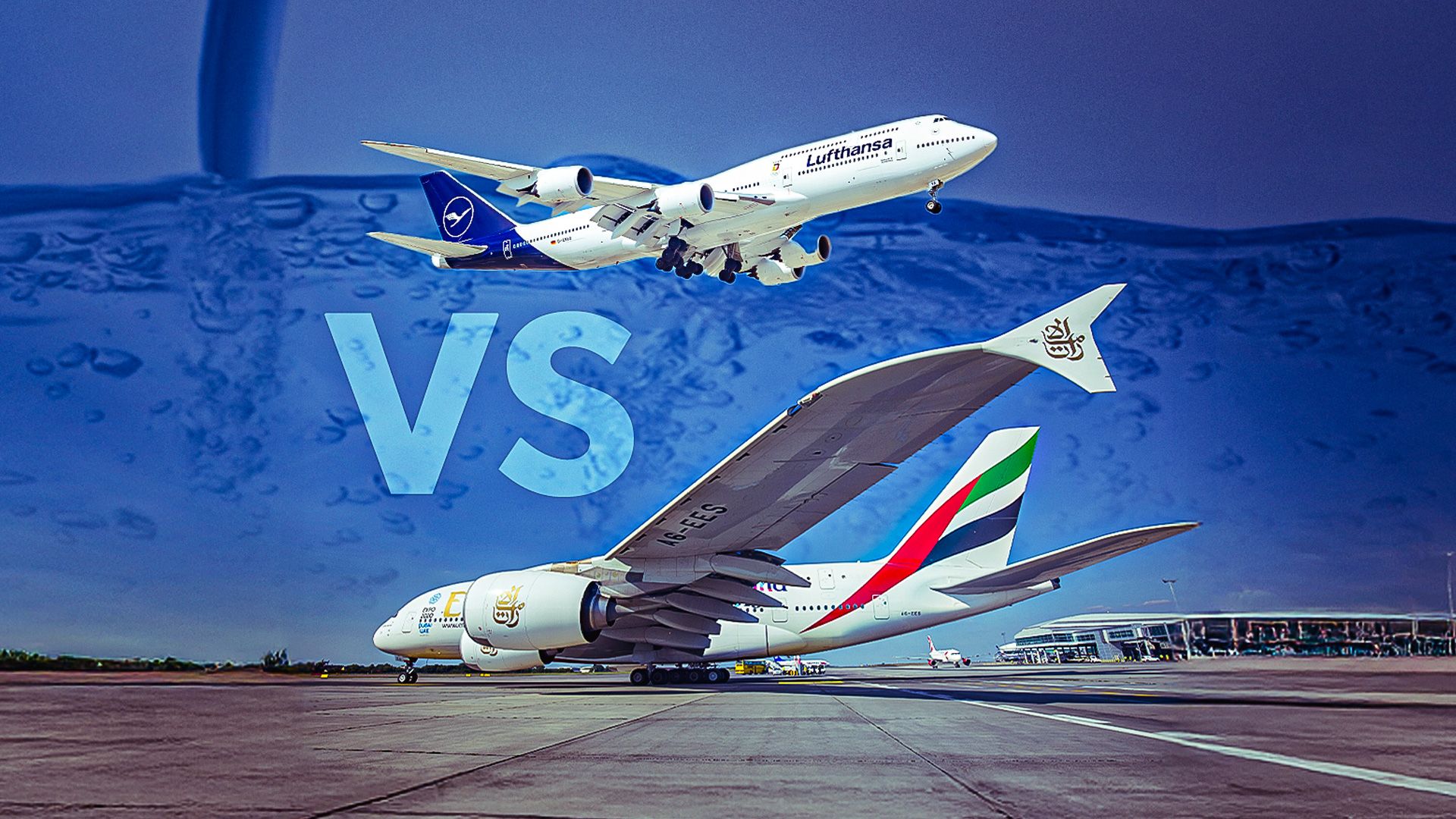
The Boeing 747 and Airbus A380 are super-large twin-decked aircraft, and are the largest aircraft offered on the commercial market by the two competing manufacturers. While being so large makes these aircraft great for carrying the highest number of passengers on long-haul routes, the increase in size means that these two quad-jet aircraft drink a good deal more jet fuel than smaller jetliners.
However, because these huge jetliners have so many seats onboard, even in a standard three-class configuration, they may not be as fuel-inefficient per ticket sold as their bulk might suggest. This article will take a look at these two largest commercial aircraft in order to find out which one is more fuel-efficient per passenger. The aircraft will also be compared with smaller aircraft which are popular on long-haul routes.
How Fuel-Efficient Per Seat Are They?

According to a Quora thread, in which a user calculated the fuel-efficiency per seat of the Airbus A380 and Boeing 747, perhaps unsurprisingly, the newest variant of the 747, called the 747-8, was the most fuel-efficient per passenger, as shown by the table below. Fuel efficiency per passenger is worked out as the number of liters of jet fuel required to transport one passenger over a distance of 100 kilometers.
|
Fuel efficiency, by distance and the number of passengers |
|||
|
Aircraft |
Passengers |
Distance |
Fuel-Efficiency per Person |
|
A380 |
554 PAX |
11,000 km |
3.16 L/100 km/PAX |
|
B747-400 |
487 PAX |
10,147 km |
3.16 L/100 km/PAX |
|
B747-8 |
467 PAX |
11,000 km |
2.82 L/100 km/PAX |
This shows that the B747–8 is the most fuel-efficient aircraft of the three when taking into account the number of passengers each variant can carry in a standard configuration. These general figures can serve as a rough measure of which is most fuel-efficient per passenger, and the margin is large enough to show a clear winner. While the 747-8 is around 20 feet longer, with a 30-feet wider wingspan than other 747 variants, its efficiency is significantly improved through the use of more modern engines and aerodynamic improvements, among other things.
Unfortunately for Boeing, and for fans of these large commerical aviation monsters, the 747-8 variant was not the manufacturer’s most popular product. Boeing only received a total of 155 orders for the variant, as it arrived during the rise of point-to-point commerical aviation model, and during the decline of the hub-and-spoke model. According to Aviation Week, Lufthansa ordered the most of these aircraft, obtaining 81 of the 155, with many being used by freight companies.
An Overview Of The A380 and 747

The A380 is the biggest commercial jetliner in the world, thanks to its length of 239 feet and wingspan of 261.8 feet. According to Airbus, it built 254 during its manufacturing run, which lasted from 2003 to 2021. The 747 is a little smaller, with most variants having a length of 231 feet and 10 inches and a wingspan of 195 feet and eight inches, and only featuring a partial upper deck. Boeing built a total of 1,574 747 family aircraft during its 1968 to 2023 manufacturing run.
Though the 747 was much more popular than the A380, both successfully filled a niche for airlines, and are still particularly useful for meeting passenger demand between larger and busier airport hub airports during peak travel times.
For passengers, the size of the aircraft is a huge positive, as there is more space available for each person to move, it is less claustrophobic, and the cabin is comparatively quiet compared to smaller passenger jets, despite having four engines instead of two. Having two decks provides an additional benefit of passengers being able to see more ‘airplane scenery’ during their flight, as described by a passenger who flew on an A380.
“About halfway through the flight, I walked down the stairs from the lounge and I walked the entire length of the plane’s lower deck, up the stairs and from the aft cabin of the upper deck I did an entire extra lap, without covering the same ground twice.”
There Are Some Caveats

As the basic fuel-efficiency per passenger figures above do not factor in some of the confounding factors that affect fuel-consumption in flight, there are some further things to consider, such as the weight of the aircraft, cargo, efficiency of the engines and efficiency of the wings. Also, according to discussion on Aviation StackExchange, an aircraft may typically consume about three percent of its maximum take-off weight (MTOW) in the course of startup, taxing, and takeoff.
This is because it takes the most energy to get from stationary to achieving the velocity required to achieve the necessary amount of lift to sustain flight, and this can be particularly costly for heavy aircraft such as the ones mentioned. Even after achieving flight, a further 1.5% of an aircraft’s MTOW may be consumed to get an aircraft to cruising altitude. It is only once here that aircraft achieve their lowest rate of fuel consumption.
|
Aircraft |
3% of MTOW in Jet Fuel |
|
A380 |
17,250 kg |
|
747-8 |
13,431 kg |
|
Difference |
3,819 kg |
Another point of consideration is that there is a different amount of cargo space in each of these aircraft, which does not necessarily match up with the number of seats. Thanks to a comparison by Leeham News and Analysis, which compared the amount of fuel consumed when standardizing the amount of cargo weight per seat, it was revealed that the A380 is less fuel-efficient than the 747-8 per tonne/kilometer in this way, but also that the 747-8 is more efficient per tonne/kilometer than a smaller common Boeing widebody, the 777–300ER.
- A380: 0.288 L/t.km
- 747–8i: 0.254 L/t.km (11.8% lower vs A380)
- 777–300ER: 0.266 L/t.km (7.6% lower vs A380)
Many Airliners Are Close In Terms Of Efficiency

Having a high number of seats, and a larger aircraft as a result, presents a trade-off for airlines. Being able to transport a high number of passengers in this way is very valuable to airlines in some cases. Still, the elevated costs of operating a heavier and bigger plane are quite apparent, particularly with the older variants of the A380 and 747. The 747-8 appears to be the exception, thanks to the significant impact of modern efficiency-increasing technology.
Bearing in mind that the 747-8 has a fuel-efficiency per passenger of 2.82 L/100 km/PAX and can carry 467 passengers in a typical configuration for a range of 14,320 kilometers, the 747-8 is quite close in terms of fuel-efficiency per passenger to many other airliners commonly used in the industry today, as shown in the following list of aircraft and their key efficiency figures, as compiled by the i6 Group:
|
Aircraft |
Typical Seating |
Range |
Fuel Capacity |
Efficiency per Passenger |
|
Boeing 787-9 |
290 |
14,140 km |
126,372 litres |
2.31 L/100 km/PAX |
|
Airbus A350-900 |
315 |
15,327 km |
166,488 litres |
2.39 L/100 km/PAX |
|
Airbus A330-900neo |
300 |
13,334 km |
139,090 litres |
2.48 L/100 km/PAX |
|
Boeing 787-8 |
242 |
13,620 km |
126,917 litres |
2.77 L/100 km/PAX |
|
Airbus A350-1000 |
350 |
16,112 km |
164,000 litres |
2.39 L/100 km/PAX |
|
Boeing 787-10 |
330 |
11,910km |
126 370 litres |
2.31 L/100 km/PAX |
Compared to these modern aircraft, the 747-8 can compete quite well, while providing the benefit to airlines of ferrying over 100 more customers per flight than the A350-1000. The leading aircraft among commercial airliners, which does not appear on this list, is the Airbus A330neo, which offers the lowest fuel consumption per seat, equal to 2.1 L/100 km/PAX. Putting into perspective how impressive these figures are, a mid-sized SUV uses 2–2.25 liters per 100 kilometers per passenger.
Layout Choices Can Dramatically Affect Efficiency

Despite the analysis done thus far, the figures are highly dependent on which configuration an airline chooses to use. In the case of Lufthansa, which flew both the A380 and the 747-8, their configurations ended up with the A380 being more fuel-efficient per passenger. As the A380 burns 13.78 kg of fuel per kilometer, which is 31% more than the 747-8, which burns 10.54 kg per kilometer, a flight must accommodate 31% more seats to reach the same efficiency.
Lufthansa flies several long 747 routes from its Frankfurt hub, and configured the A380 and 747-8 as follows:
- A380 configuration: 8 first, 78 business, 52 premium economy, 371 economy = 509 seats
- B747-8 configuration: 8 first, 80 business, 32 premium economy, 244 economy = 364 seats
Thus, the Lufthansa A380 has 40% more seats than the Lufthansa 747-8, making it more efficient per passenger. This is only provided that they can fill the seats, and that is perhaps the most critical factor in all of this. When looking to invest in one of these large planes, an airline has to balance the likelihood of filling it with paying customers against the expenditure of operating it, so it is easy to see why they may tend towards the ‘safer’ option of purchasing a smaller aircraft.
Advancements in efficiency technology have also drastically extended the maximum ranges of modern midsize jetliners, allowing them to operate more mid-to-long range routes. Increased flexibility in modern aircraft means that the niche where large-capacity aircraft like the A380 and 747 are optimal is becoming increasingly smaller, even as technology makes them more economically viable.

- Launch Customer(s)
-
Pan American World Airways
- First Delivery
-
January 22, 1970
link
About the Author