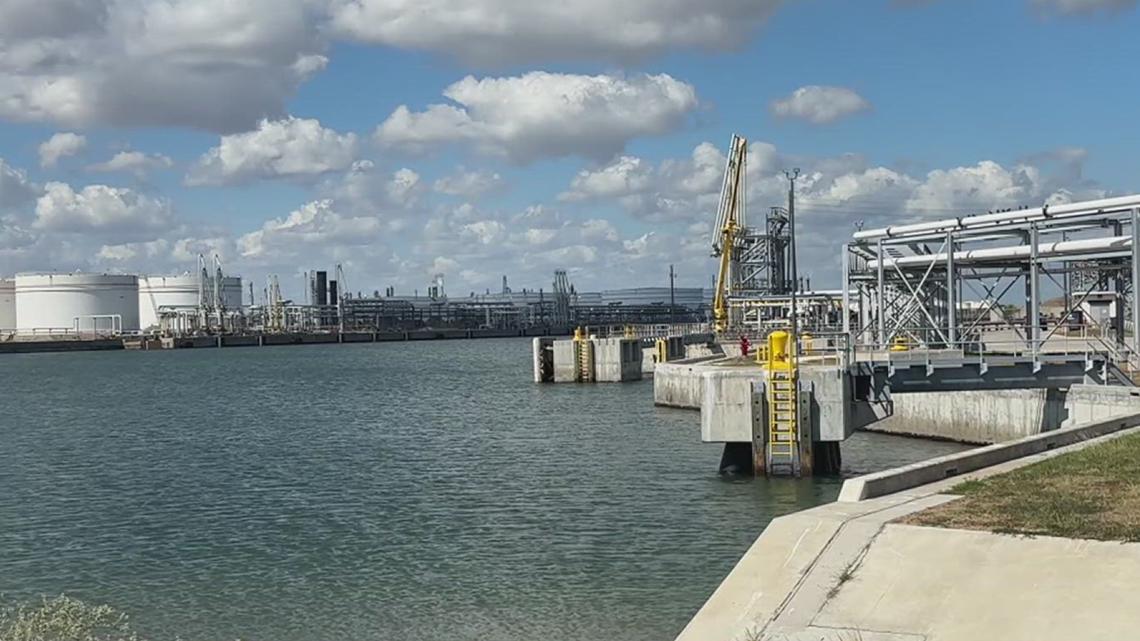
Talks with CC Polymers fell through after the company rejected the city’s bid for its desal plant, citing ownership issues and costly $650M expansion
CORPUS CHRISTI, Texas — Talks over the future of the Corpus Christi Polymers facility have fallen through after the company formally declined to move forward with the city’s proposal to acquire its desalination property.
RELATED: City looking to buy a desal plant for some $650 million
In a letter dated Oct. 23, 2025, CC Polymers Chief Operating Officer Jeff Shea told City Manager Peter Zanoni that the company “decided not to proceed with the proposed discussions regarding the potential acquisition of our Desalination property at this time.”
Shea wrote that the decision reflected the company’s “current operational priorities and strategic direction,” but said CC Polymers remains open to “exploring alternative forms of collaboration,” including a potential water-supply agreement, future expansion for additional capacity, or a land-lease arrangement for a city project.
Councilman Mark Scott said the setback highlights how the plant’s complex ownership—shared by three competing companies—has delayed decisions – making and slowed progress.
“They need to figure out what their future looks like before they have any more conversations,” Scott told 3NEWS. “We wish CC Polymers the best. I think part of the issue is it’s owned by three competing companies, and they’re all trying to figure out what the future is.”
Scott said part of the permit to operate the neighboring Dow Chemical facility depends on the polymers plant being online, since the two share wastewater infrastructure. He said treated industrial water from one site is combined with brine discharge from the other, meaning both facilities must operate together under the same regulatory permit.
Scott said taking over the polymers facility would be a lengthy and complicated process for the city.
“It would be a long haul for the City of Corpus Christi to take over that facility,” he said. “You’d have to get new permits, and that would be difficult.”
Scott also clarified that the CC Polymers project was never part of the city’s official water supply strategy.
“The project was never included in our overall water plan,” he said. “Conversations (were) too premature for that.”
During an October presentation to City Council, Zanoni said the desalination facility tied to CC Polymers could initially produce about 10 million gallons of water per day. He said expanding the plant to roughly 30 million gallons per day would cost an estimated $650 million.
Zanoni told 3NEWS on Monday that the project was never considered part of the city’s water supply plan.
“The CC Polymers water was not factored into our water availability planning strategies,” he said.
Councilwoman Carolyn Vaughn agreed, saying the project was never a key part of their drought planning efforts.
“No, we were not,” Vaughn said. “I was never on board for CC Polymer. That equipment has sat there for 10 years, and there are three partners, so I was concerned about that as well. It was just another option to look at. It would have had to have substantial work done to complete. I didn’t feel like it was a viable option.”
But City Council is still on the hunt for water, and they have multiple options on the table.
“I think the ones we are looking at coming up are the wastewater reuse and the Barney Davis plant,” she said.
As Corpus Christi faces one of the worst droughts in its history, those projects will be key in helping expand local water supplies and avoid stricter conservation measures.
link
About the Author